Food and nutrition are once again gaining attention across the country, and several recent changes from the U.S. Department of Agriculture (USDA) have a direct impact on what children eat at school, how schools purchase food, and how communities connect with local farmers.
Between updated nutrition guidelines, newfound freedoms in procuring local, and evolving requirements for child nutrition program (CNP) operators, the USDA changes can be a lot to keep straight. These recent changes create new opportunities to support healthy eating and connect children with fresh, local foods.
Whether you’re a parent, educator, or just an invested member of the community, understanding these changes can help you stay informed and find new ways to encourage healthy eating in your own life. Let’s take a look at some of the most important USDA developments from this year and what they might mean for Ohio schools and families.
Feed Our Future’s Big 3:
1. New Dietary Guidelines Put Child Nutrition Back in the Spotlight
On January 7th, 2026, the USDA and the U.S. Department of Health and Human Services released the new 2025-2030 Dietary Guidelines for Americans. These updated guidelines offer recommendations for healthy eating, serve as a foundation for nutrition education, and include new guidance for CNPs.
The new Dietary Guidelines for Americans introduced the “New Pyramid.” Unlike the old pyramid, which many of you may remember from your own childhood, this pyramid is “upside down” with the largest part being at the top to emphasize that the largest chunk of our diets should be made up of “whole, real foods.” Consider the following list of foods: apples, potato chips, eggs, cereal, and carrots. Do YOU know which of these are considered whole foods and which are considered processed? (You can find the answer at the end of this blog post!)
These new guidelines also place a specific emphasis on the importance of child nutrition program directors and school nutrition professionals by acknowledging that most meals that American children eat are served while at school or in childcare.
2. More Flexibility in School Meal Purchasing
The USDA has also taken another exciting step towards making it easier for CNP operators and school nutrition professionals to procure locally grown and raised products. In September 2026, the USDA clarified its regulations regarding the ability to use “geographic preference” language when writing procurement specifications. Geographic preference may sound confusing, but really, it just refers to the way schools or CNP operators can express a desire for the products they source to be locally grown or raised. CNP operators are now officially able to use “locally grown, raised, or caught” when writing product specifications.
For example, before the beginning of the school year, a school nutrition professional might know that they want to order 1,000 apples for grab-n-go breakfasts in August. They would fill out a form called a “product specification” where they describe how many apples they want, when they want them, and where they want the apples to be from. The freedom to use geographic preference when writing bid specifications allows schools to specifically order Ohio-grown apples. Local food usually travels fewer distances to reach schools, resulting in more nutritious apples for students, a stronger local food system, and economic benefits that stay in our state.
This clarification is also incredibly important for small and medium-sized farms that are interested in supplying food to schools but have historically faced challenges in meeting school purchasing requirements. The ability for CNP operators to use their own language when procuring food allows for small and medium-sized farms to have a better chance at winning the partnership, since serving apples from a local farm might be more important to a school than having a never-ending supply of apples.
3. Changes to Child Nutrition Program Milk Options
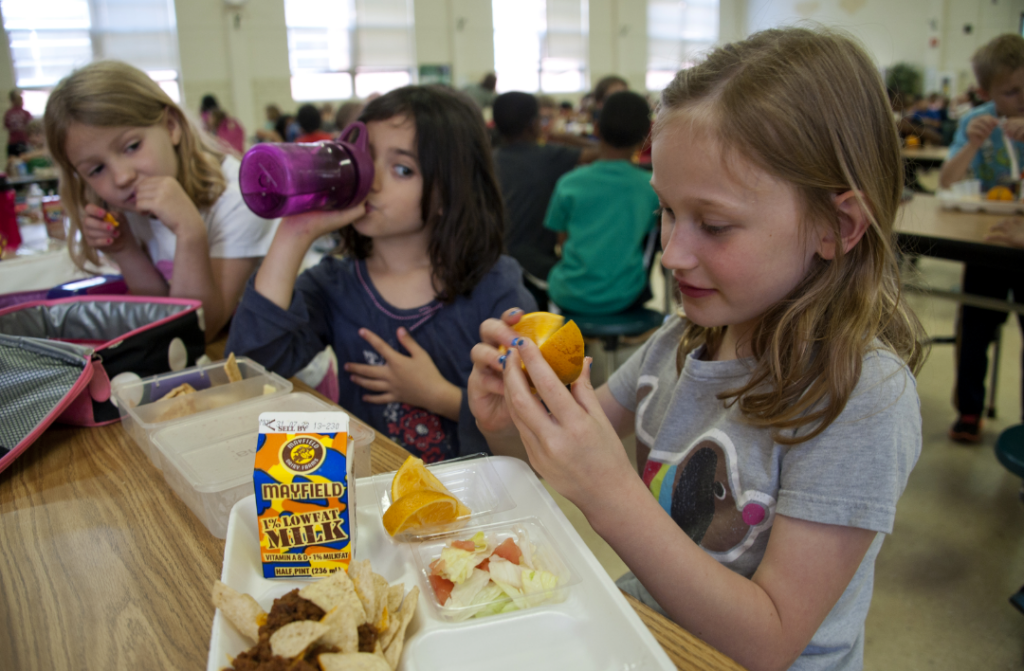
Finally, in May of 2026, the USDA released the Whole Milk for Healthy Kids Act, updating the list of milk options that CNP operators can serve children aged 2 and up during meals. Previously, low-fat and fat-free milk were the only options schools could offer children if they wanted to be reimbursed by the government. Now, school nutrition professionals and CNP operators have the option of serving whole milk or reduced fat (2%) milk in addition to low-fat or fat-free milk.
Not only does this give school nutrition professionals additional flexibility for planning and serving meals to students, but it also increases the number of dairy farmers and producers who are now eligible to sell to schools. Adding more types of milk to the list of allowable options increases the overall demand for milk in CNPs, ultimately supporting dairy farmers and our local economy.
With all of these updates, one thing is clear: food and nutrition standards and regulations in the United States are constantly evolving, and in many cases, for the better. The recent changes made by the USDA create an environment where eating healthy, nutritious food is celebrated and schools have a greater ability to buy from local farmers and producers. For communities in Ohio, these changes provide opportunities to build a resilient local food system whose benefits stretch far further than the borders of our state.
Thanks for reading this far! The answer to the whole foods question: apples, eggs, and carrots are considered whole foods, while potato chips and cereal are processed.
As always, be sure to follow our socials:
Instagram: @feedourfutureohio
Facebook: Feedourfutureohio